
Best Business Checking Accounts With Low or No Monthly Fees in 2026

Best Business Checking Accounts
Opening a business checking account is one of the first real steps after forming an LLC or launching a company in the United States. For many new entrepreneurs, especially immigrants and first-time founders, the monthly fee is the first surprise.
The best business checking accounts with low or no monthly fees in 2026 include Bluevine, Novo, Mercury, and select traditional banks with waivable fees like Chase and Bank of America. The right choice depends on transaction volume, cash needs, and eligibility requirements.
Some banks charge $15 to $30 per month just to keep the account open. Others advertise “free” accounts that only stay free if you maintain a minimum balance or meet transaction requirements.
In 2026, there are still strong options with low or no monthly fees, but the details matter. The best account for a freelancer is not always the best option for a retail business or a startup planning to raise funding and the FDIC deposit protection is not the same.
This guide focuses on:
- Business checking accounts with low or zero monthly fees
- Real waiver conditions
- Hidden costs to watch for
- Options suitable for new immigrants or ITIN holders
We are not ranking banks based on advertising. We are comparing structure, flexibility, and real cost exposure.
What to Look for in a Low-Fee Business Checking Account
A “no monthly fee” label does not automatically mean low cost. Before choosing a business bank account, consider the full structure.
Monthly Maintenance Fee
Some banks charge no monthly fee at all. Others waive it if you:
- Maintain a minimum balance
- Make a certain number of transactions
- Receive a minimum amount in deposits
If your cash flow fluctuates, minimum balance requirements can become expensive quickly.
Transaction Limits
Many business checking accounts include a limited number of free transactions per month.
After that limit, banks may charge per transaction. This can matter if you:
- Run a high-volume e-commerce business
- Deposit cash frequently
- Process multiple vendor payments
Freelancers with low transaction volume are less affected by these limits.
Cash Deposit Policies
Online banks often offer strong digital features but limited or restricted cash deposit options.
If your business handles physical cash, you should check:
- Monthly cash deposit limits
- Per-deposit fees
- Partner ATM network availability
For service-based or remote businesses, this may not matter at all.
ATM Access and Fees
Some banks reimburse ATM fees nationwide. Others charge for out-of-network withdrawals.
If you travel frequently or operate in multiple states, ATM flexibility becomes more important.
Online Banking and App Quality
For many new business owners, the banking app becomes the control center of the company.
Look for:
- Real-time notifications
- Easy wire transfers
- Mobile check deposit
- Integration with accounting tools
Digital-first banks often excel here.
Ease of Approval for New Entrepreneurs
This is especially important for immigrants.
Some banks require:
- Social Security Number
- Established credit history
- In-person branch visits
Others are more flexible and may accept:
- ITIN
- EIN-only structure
- Remote verification
Approval friction is often overlooked until the application is rejected.
Quick Comparison: Low-Fee Business Checking Accounts in 2026
Before diving into details, here is a simplified comparison of strong business checking options known for low or no monthly fees in 2026.
| Bank | Monthly Fee | Minimum Balance | Best For |
|---|---|---|---|
| Bluevine | $0 | None | Online businesses |
| Novo | $0 | None | Freelancers |
| Chase Business Complete | Waivable | Required to waive | Cash-heavy businesses |
| Bank of America | Waivable | Required to waive | Traditional businesses |
| Mercury | $0 | None | Startups & tech founders |
This overview focuses on structure, not marketing promises. If your priority is zero fixed cost, online-first banks dominate. If your business handles physical cash, branch access becomes more important.
Bluevine Business Checking
- Monthly fee: $0
- Minimum balance: None
- Best for: Online businesses, freelancers, service providers
Novo Business Checking
- Monthly fee: $0
- Minimum balance: None
- Best for: Solopreneurs, digital entrepreneurs
Chase Business Complete Banking
- Monthly fee: Typically charged, waivable
- Minimum balance required to waive
- Best for: Businesses needing branch access and cash deposits
Bank of America Business Advantage Fundamentals
- Monthly fee: Charged, waivable with balance requirement
- Strong branch network
- Best for: Traditional businesses
Mercury Business Account
- Monthly fee: $0
- Minimum balance: None
- Best for: Startups, tech founders, venture-backed companies
Now let’s break down how these accounts actually work.
Bluevine Business Checking
Bluevine has positioned itself as one of the strongest no-monthly-fee business checking accounts for online businesses.
There is no monthly maintenance fee and no minimum balance requirement. This makes it attractive for new entrepreneurs who want cost predictability.
Strengths:
- No monthly fee
- Unlimited transactions
- Competitive interest potential (depending on balance structure)
- Strong online dashboard
Limitations:
- No traditional branch access
- Cash deposits may involve partner locations
Best for:
Service-based businesses, consultants, remote founders, and digital companies that operate primarily online.
Novo Business Checking
Novo is a digital-first business bank focused on simplicity.
There is no monthly fee and no minimum balance requirement. The onboarding process is streamlined and often faster than traditional banks.
Strengths:
- No monthly maintenance fee
- Strong integrations with tools like Stripe and Shopify
- Clean mobile experience
Limitations:
- No cash deposit network of its own
- Not ideal for high cash-volume businesses
Best for:
Freelancers, online sellers, creators, and early-stage LLC owners.
Chase Business Complete Banking
Chase is one of the largest traditional banks in the United States.
This account typically includes a monthly fee, but it can be waived if certain balance or transaction requirements are met.
Strengths:
- Large branch network
- Strong ATM access
- Easier cash deposit handling
- Recognized brand credibility
Limitations:
- Monthly fee if requirements are not met
- Transaction limits in basic plans
Best for:
Retail businesses, restaurants, and companies that handle physical cash or prefer in-person banking.
Bank of America Business Advantage Fundamentals
Bank of America offers structured business accounts with national reach.
The monthly fee can be waived depending on average monthly balance.
Strengths:
- Wide branch presence
- Strong support for established businesses
- Cash deposit capability
Limitations:
- Monthly maintenance fee if balance is low
- More traditional onboarding requirements
Best for:
Businesses that want stability, brand recognition, and physical branch access.
Mercury Business Account
Mercury is popular among startups, especially tech founders and venture-backed companies.
There is no monthly fee and no minimum balance requirement.
Strengths:
- No monthly maintenance fee
- Startup-friendly structure
- Remote onboarding
Limitations:
- Not ideal for cash-heavy businesses
- Focused more on digital-first companies
Best for:
Tech startups, SaaS founders, and international entrepreneurs launching US-based companies.
Best Business Checking Accounts for New Immigrants or ITIN Holders
For many new arrivals in the United States, opening a business bank account is not just about fees. It is about eligibility.
Some banks require:
- A Social Security Number
- Established US credit history
- In-person branch verification
Others are more flexible.
If you are a new immigrant, international founder, or ITIN holder, you should prioritize banks that:
- Allow EIN-based applications
- Offer remote onboarding
- Have simplified identity verification
- Do not require prior US banking history
Online-first institutions often provide smoother approval experiences, especially for digital businesses.
However, if your business involves significant cash deposits, traditional banks with branch networks may be easier to work with long term.
Choosing the right structure early can prevent account freezes or compliance issues later.
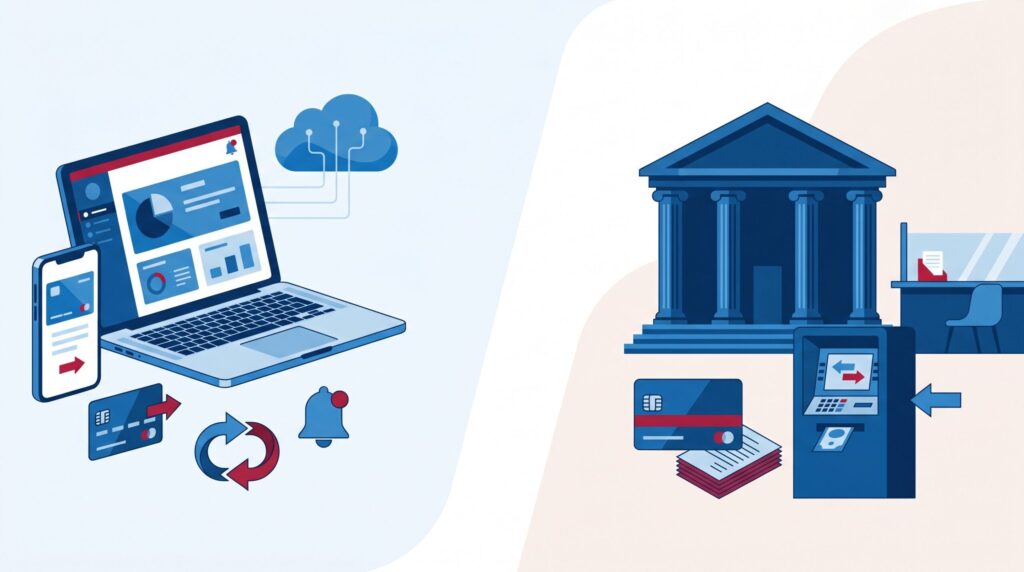
Online Banks vs Traditional Banks: Which Is Better?
There is no universal answer.
Online business banks typically offer:
- No monthly fees
- No minimum balance
- Modern dashboards
- Faster onboarding
Traditional banks typically offer:
- Branch access
- Easier cash deposits
- Physical support
- Broader product ecosystem
If your business operates digitally and rarely handles cash, online banks often provide lower overall costs.
If you operate a restaurant, retail shop, or service business with physical transactions, traditional banks may be more practical.
Your business model should guide your decision, not advertising.
Hidden Business Banking Fees to Watch For
Even “no monthly fee” accounts can generate unexpected costs.

Watch for:
Wire transfer fees
Domestic and international wires can be expensive.
Cash deposit limits
Some accounts cap free monthly deposits.
Out-of-network ATM fees
Not all banks reimburse.
Excess transaction fees
Accounts may include transaction limits.
Inactivity fees
Rare, but still present at some institutions.
Reading the full fee schedule before opening an account is one of the simplest ways to avoid surprises.
Frequently Asked Questions
What is the cheapest business checking account in 2026?
Several digital banks offer business checking with no monthly fee and no minimum balance. The best choice depends on transaction volume and cash handling needs.
Which bank has no monthly fee for business accounts?
Some online banks provide truly zero monthly fee structures. Traditional banks often waive fees only if balance requirements are met.
Can I open a US business checking account without an SSN?
Some banks allow applications using an EIN and ITIN, but requirements vary. Online banks are often more flexible than traditional institutions.
Do I need an LLC to open a business checking account?
Most banks require a registered business entity such as an LLC, corporation, or sole proprietorship with an EIN.
Are online business banks safe?
Reputable online banks operate with regulatory oversight and banking partners. Safety depends on the institution’s structure and compliance framework.
In the end
The best low-fee business checking account in 2026 depends less on marketing claims and more on how your business actually operates.
If your goal is minimizing fixed costs, digital-first banks often provide the strongest value.
If your business relies on cash deposits or branch access, a traditional bank with a waivable monthly fee may be more suitable.
Choosing the right banking structure early can reduce operational friction and unnecessary expenses as your business grows.


One Comment